Patient Notes: 2/18/2020
Evelyn Carter, 7 y.o female, No Diagnosis – Emergency Appt
- Red marking on forehead and behind ears, cleft lip and wide-set eyes. Difficulty speaking and with basic language comprehension and development.
- Unknown diagnosis- potential genetic factor?
- Prescription: Whole-Exome Sequencing, Microarray
For the longest time, patients like Evelyn were treated by physicians based on the doctor’s previous experience alone. Individuals were grouped together based on their phenotype, or physical symptoms, and then treated with what was known to work in patients that came before them. However, with the racing modern advancements in genomics, it’s become possible to understand what makes Evelyn tick, and what exactly causes her delayed learning and difficulty speaking. What is that thing, you may ask? The answer lies in her genetic code.
Whole-exome sequencing (WES) is a novel technique of DNA sequencing that focuses on identifying portions of the genome that code for proteins. It occurs in numerous steps: breaking the genome apart, using target-enrichment strategies to identify exons (the coding regions), separating them from non-coding regions, and then sequencing the exons to interpret results (Frey 2016, par. 5) . WES is used mainly for its efficiency, low cost, and usefulness in studying rare conditions (Frey 2016, par. 7-9). In terms of applications, WES has been used in a variety of settings since the earliest discoveries of disease-causing mutations in 2009, including research and clinical diagnosis (Frey 2016, par. 13). By sequencing exomes, physicians are able to identify exactly what sets Evelyn apart from her unaffected classmates, and can point to potential conditions that she may have. It is truly a translational process that requires not only physicians, but patient consent, analysts and a support system of medical professionals, as outlined in Figure 1.
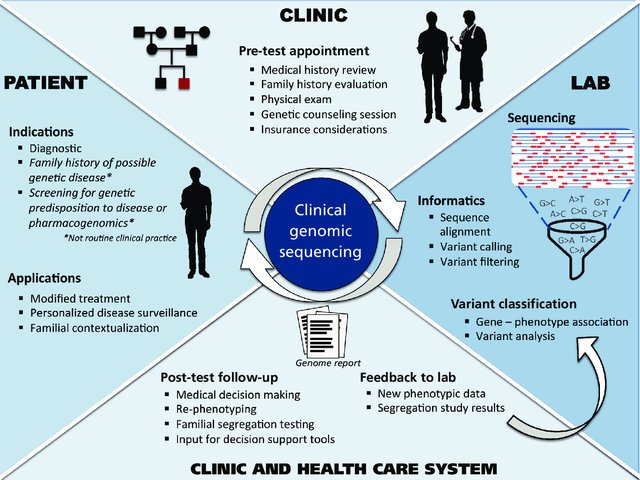
Credit: Krier, et.al
The NCGENES project is a clinical trial in Chapel Hill that is using WES to analyze around 750 children and adults with genetic disorders but has not been properly diagnosed, like Evelyn (Foreman 2013, par. 5). By studying patients with a wide variety of ailments, such as cancer, cardiogenetic diseases, and neurodevelopmental disorders, the NCGENES project attempts to identify significant portions of the genome that may be causing the disease or condition (Foreman 2013, par. 5). This project is hoped to allow physicians to assess the accuracy at which WES can be utilized, and in which cases and patient groups it will be most effective. Much of the current clinical research, including the groundbreaking project at UNC, is focusing on how to effectively use clinical sequencing to improve health care outcomes of patients, and whether or not it can be used productively in preventative health.
Unfortunately, with the advancement in clinical genomics comes an abundance of questions. For example, deciding what information should be communicated from the sequencing to patients, or who has the expertise to translate findings, and potentially ethical, legal and social implications (Berberich et al. 2018, p. 2). Although the ethics of genomic sequencing in the clinic have yet to be seriously assessed, it is no secret that the technology has a multitude of potential applications, as exemplified in projects being executed in North Carolina. This can be used as a progressive tool for healthcare professionals in order to offer personalized treatment plans for patients, as well as create diagnoses for patients like Evelyn.
References
Berberich AJ., Hegele R. 2018. “Whole genome sequencing in the clinic: empowerment or too much information?” CMAJ: Canadian Medical Association Journal, p. E124+. [accessed 2020 Jan 25]. https://www.ncbi.nlm.nih.gov/pmc/articles/PMC5798981/
Biesecker L, Burke W Kohane I, Plon SE, Zimmern R. 2012. “Next-generation sequencing in the clinic: are we ready?” Nature Reviews Genetics, vol. 13, no. 11, p. 818+. [accessed 2020 Jan 25]. https://www.ncbi.nlm.nih.gov/pmc/articles/PMC3891793/
Foreman AK, Lee K, Evans JP. 2013. The NCGENES Project: Exploring the New World of Genome Sequencing. North Carolina Medical Journal. [accessed 2020 Jan 25];74(6):500-4. http://classic.ncmedicaljournal.com/archives/?74610
Frey RJ. 2016. “Exome Sequencing.” The Gale Encyclopedia of Genetic Disorders, edited by Tracie Moy and Laura Avery, 4th ed., vol. 1, Gale, pp. 650-655. Gale In Context: Science, [accessed 2020 Jan 25]. https://link.gale.com/apps/doc/CX3630400182/SCIC?u=ncliveuncch&sid=SCIC&xid=bc4a7b4dRehm HL. 2017. “Evolving health care through personal genomics.” Nature Reviews Genetics, vol. 18, no. 4, p. 259+. [accessed 2020 Jan 25]. https://www.nature.com/articles/nrg.2016.162?proof=true
Krier J, Kalia S & Green R. 2016. “Genomic sequencing in clinical practice: Applications, challenges, and opportunities.” Dialogues in Clinical Neuroscience. 18. 299-312.
Rehm HL. 2017. “Evolving health care through personal genomics.” Nature Reviews Genetics, vol. 18, no. 4, p. 259+. [accessed 2020 Jan 25]. https://www.nature.com/articles/nrg.2016.162?proof=true
 rajee's blog